

Changing Hotels: Our first task of the day was to check out the new hotel. After taking a look at the room and checking the internet connection, Peep and I decided to make the move to the new hotel. Phout stayed in our original hotel and therefore had to move to a different, more expensive room for the night before changing back to his original room type the following night. We return to our original hotel, packed up, checked out, and made our way to the new hotel, which was within walking distance.
The only activity for the first day of the expo was short presentations and discussions on cultural tourism in Vietnam and the surrounding counties, and it was geared toward government officials only. Peep and Phout planned to be at the hotel where the discussions were taking place at 2:00 to set out brochures, after which they would meet up with me. This meant the remainder of the morning was free, allowing them a little sightseeing time. Since she had to work the next several days, I let Peep pick the one place she wanted to visit most. She chose the Reunification Palace.

Reunification Palace: The palace was originally constructed in 1868 for the French Governor in the south of Vietnam and named Norodom Palace. In 1954 the French withdrew from Vietnam and the palace was handed over to Ngo Dinh Diem, Prime Minister of what now became known as the Republic of Vietnam (aka South Vietnam). The new PM, who was backed by the Americans, renamed to palace to Independence Palace. In 1962 the left wing of the palace was destroyed in a coup d'etat attempt. Ngo Dinh Diem decided to have the rest of the building demolished and a new palace erected in its place. Finally, since 1975, after the fall of Saigon and reunification of North and South Vietnam, the palace has been known as Reunification Palace.

The First Floor: The Palace is still used today for official functions, although it is not permanently occupied. Located on the first floor of the palace is the Cabinet Meeting Room, the Banquet Room and the Conference Hall.


The Second Floor: On the second floor is the President's office, the President's and Vice President's receptions rooms, and the Credentials Presenting Room (pictured above), where diplomats for the Republic of Vietnam presented their credentials to be ambassadors of the state.
At the back of the palace on both the second and third floors is the living quarters of the president. There is a small garden, private dinning room, and a couple bedrooms on the second floor. The third floor contains the president's bedroom but is not included in the tour.


The Third Floor: The library, First Lady's Banquet Room, a movie theater and a gambling room are all located on the third floor. Also on the third floor is the heliport.
The Fourth Floor: Finally, the top floor consisted solely of the Four Directions Tower, which includes a bar, stage, and dance floor. Looking down on the heliport, you can see where two bombs stuck the palace after being dropped by a spy in the South Vietnamese military. Originally sent out to bomb North Vietnamese troops, he turned his plane around, bombed the palace, and was then able to safely land in North Vietnamese controlled territory.

The Basement: From the fourth floor, our tour continued to the basement, which was constructed as a bunker and equipped with the latest radio equipment so the war could be carried out even if the palace was under attack. Apart from the command and control center, living quarters for the officers and the president are also located in the basement, with a separate staircase leading from the president's office to the bunker to be used for a quick getaway.
Ground Level: Going up one level we toured the kitchen. The ground level was reserved for the staff taking care of the palace. Also on the grounds of the palace are replicas of the tanks that crashed through the gates when the palace was seized and a replica of the plane the spy flew to drop bombs on the palace.
Lunch: After our tour of the palace, Peep, Phout and I went out for lunch at a restaurant near the palace. After lunch, Peep and I parted ways as she went to set up the brochures and I headed in the opposite direction to the War Remnants Museum.

Xa Loi Pagoda: Upon arriving at the War Remnants Museum I discovered it did not open until 1:30, not 1:00 as I had originally thought. Since I had a half hour to kill, and there was a pagoda just a few blocks away, I decided to make a detour before visiting the museum. I found the Xa Loi Pagoda without much problem but it was closed when I arrived, not opening until 2:00. That was okay because I did not plan on going inside anyway. Just after I started my return trip to the museum it started raining. Fortunately, the rain stopped before I finished touring the museum and did not return the rest of the day.


War Remnants Museum: After paying the 15,000 dong ($.92) admission fee, I began my tour of the museum. The museum was almost entirely dedicated to the suffering of the Vietnamese people at the hands of American forces during the Vietnam War. There are eight permanent exhibits including one on the causes of aggressive wars, a second one showing pictures taken by war reporters killed during the conflict, a third one dedicated solely to the pictures taken by two Japanese war reporters, and a fourth one a mock-up of the prisons used in South Vietnam for political prisoners, focusing on the "Tiger Cages", small cells with grating on top. Up to 16 people may be locked up in one cell, the prisoners having to take turns standing by the door just to get some fresh air.
Perhaps the most graphic of the exhibitions is one showing pictures of bodies mutilated by American weapons and American forces. It also showed the effects of napalm and agent orange, including pictures of those with birth defects. Juxtaposed to these disturbing photographs are drawings of war and peace made by Vietnamese school children.
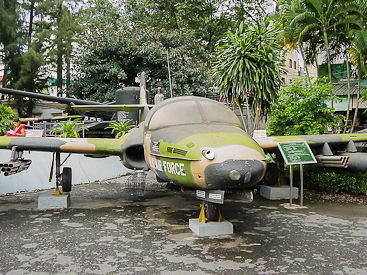
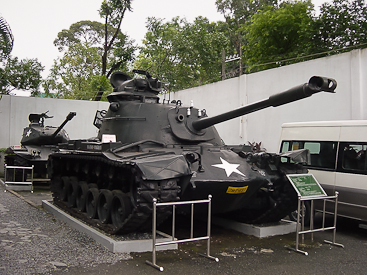
Also on the grounds of the museum is quite an impressive display of American weaponry used during the war. There are several buildings on the grounds of the museum, so the weaponry was crowded together, which I found a little odd since the main building has three levels and only the first is used for displays. The final exhibition was titled "International Support for the Vietnamese People in their Resistance War" but dealt almost exclusively with anti-American protests the world over.

Notre Dame Cathedral: After spending just over an hour in the War Remnants Museum, I headed back in the direction of the hotel to the Notre Dame Cathedral. Our plans were to meet there after Peep dropped off the brochures at the presentation site. Upon reaching the cathedral, I received a phone call from Phout informing me that he and Peep wouldn't be joining me because they were staying for the presentation and discussion to fill in the seats reserved for the part of the Lao delegation that didn't show.
After a quick look inside the cathedral, I went back to the hotel and waited for Peep and Phout to finish so we could all head out to dinner together.