

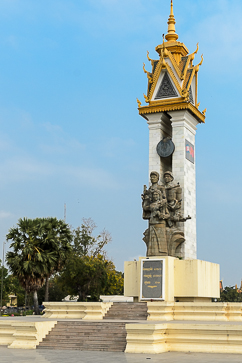
Cambodia–Vietnam Friendship Monument: Since Peep wasn't scheduled to meet until the afternoon, we spent the morning seeing some sites in downtown Phnom Penh. After breakfast at the hotel, we headed out on foot to the Royal Palace, stopping at the Cambodia–Vietnam Friendship Monument located within a park through which we passed. The monument was constructed by the communist regime installed by Vietnam after its victory over the Khmer Rouge in 1978.
Royal Palace: Our next stop was at the Royal Palace, the outer walls of which we passed the previous evening. We found the tourist entrance, purchased entry tickets and hired a guide to show us around the palace grounds. Originally constructed in 1866, many of the original wooden structures, such as the Throne Hall and Chanchhaya Pavilion, were replaced in the early 1900s. As we entered the main courtyard, we were immediately struck by the beauty of the well-kept gardens sprawled out in front of us. Just beyond the lush greenery stood the largest of the buildings within the complex - the Throne Hall.
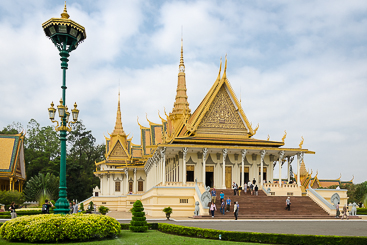
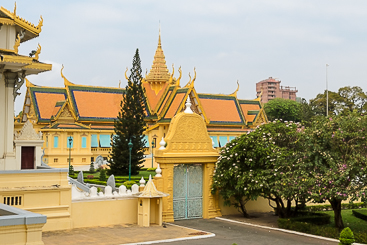
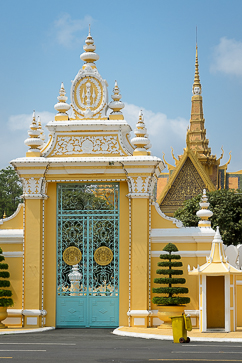
Throne Hall, Victory Gate & Khemarin Palace: The Throne Hall, or Preah Timeang Tevea Vinicchay, is the main audience hall where the king meets with foreign dignitaries. His guests arrive through the Victory Gate, located within the outer wall directly in front of the Throne Hall and reserved for use by the king and foreign heads of state only. Within the Throne Hall sits a single "big chair", as our guide liked to call it, where the king sits during his meetings. If the king were married, a second "big chair" would sit next to the one already there. Directly behind this chair is the throne upon which the king sat only for his ordination in 2004. Directly behind his throne is a second throne for the queen.
Located behind the Throne Hall and off limits to visitors is Preah Moha Prasat Khemarin, or Khemarin Palace, the royal residence. The king was not in residence at the time of our visit, indicated by the absence of the Cambodian flag above the palace, allowing some construction work on the palace grounds to occur.
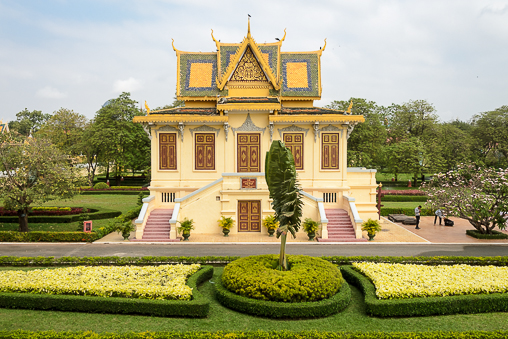
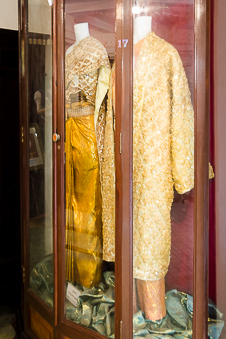
Hor Samran Phirun & Hor Samrith Phimean: Flanking the Throne Hall are two, identically designed buildings. The one to the left is Hor Samran Phirun, the Royal Rest House, where the king waited to mount his elephant for Royal processions, and where processional props were stored. Elephants are no longer kept by the king and this building is used to house gifts from foreign dignitaries, but not open for public viewing. On the opposite side of the Throne Hall is Hor Samrith Phimean, also known as the Bronze Palace. This building holds Royal regalia and costumes, some of which were on display on the ground floor.
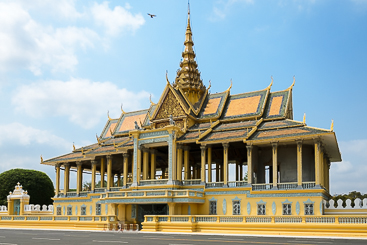
Chanchhaya Pavilion: This large pavilion, also known as the Moonlight Pavilion, forms part of the outer wall of the palace grounds and can be used by the king to address crowds gathered in the park across the street from the Palace. It also serves as the venue for the Royal Dancers and for state banquets. However, tourists are not permitted to get a close-up look at the structure.
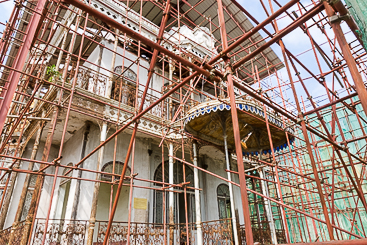
Napoleon III Pavilion: Also available for viewing on the tour is the Napoleon III Pavilion, an all-iron structure with a classical European design originally constructed for the inauguration of the Suez Canal and gifted by Napoleon to King Norodom in 1876, making it the oldest surviving structure on the palace grounds. This building was getting a much-needed face lift while we were there, and was therefor completely surrounded by scaffolding, preventing us from seeing the Royal memorabilia and photo exhibit normally on display there.
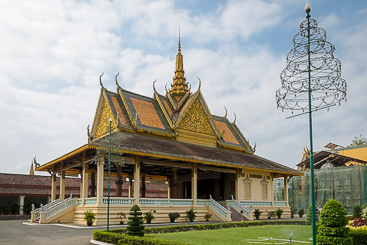
Phochani Pavilion & Damnak Chan: Located in front of the Napoleon III Pavilion is the Phochani Pavilion, used for Royal receptions and meetings. Just behind the Napoleon III Pavilion is the Damnak Chan, the administrative offices of the King and off limits to the public.
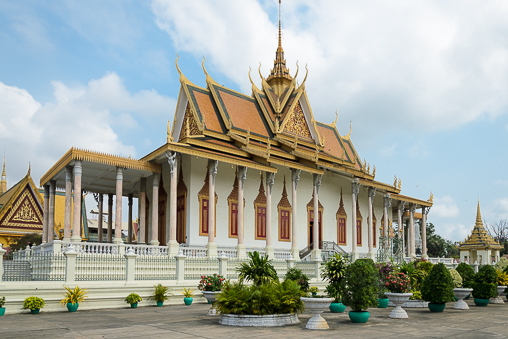
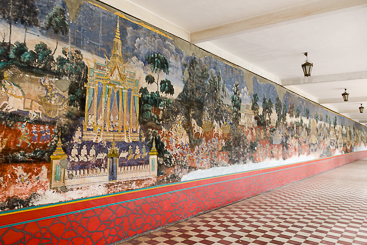
Silver Pagoda: Making our way through a walled walkway within the same compound, we came to the grounds of the Silver Pagoda, included with our admission to the Royal Palace. The largest of the structures on the compound is officially named Wat Preah Keo Morokat, or the Temple of the Emerald Buddha. However, it is commonly referred to as the Silver Pagoda, due to the 5329 silver tiles, each weighing 1.125 kg (2.48 lbs), that cover the entire floor of the pagoda.
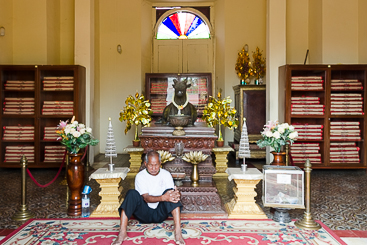
Although a limited number of ceremonies and teachings do take place here, the pagoda is primarily used as a repository for the 1650 precious objects found inside, including the emerald Buddha for which the building is named. Unlike most Buddhist pagodas, no monks stay in permanent residence here.
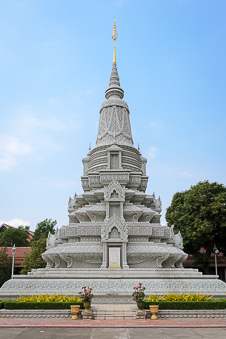
Other Structures: Also located on the Silver Pagoda grounds are numerous stupas and memorials to past members of the royal family, a library housing Buddhist texts (Mondapa of Satra and Tripitaka), an open hall used for Buddhist teachings and several additional shrines. The wall surrounding the grounds is completely covered with frescoes depicting scenes from the Ramaketi, the Khmer version of the classic Indian Ramayana, one of the great Hindu epics. Originally created in 1903-1904, the artwork fell into disrepair due to neglect during the reign of the Khmer Rouge. Some restoration has occurred, but much of the damage is still clearly visible.
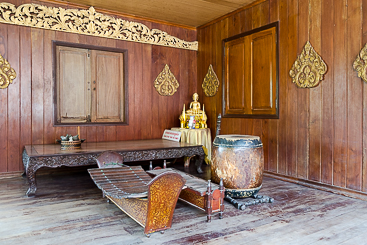
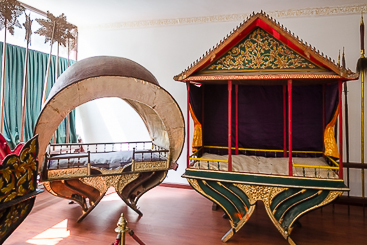
Concluding the Tour: At this point we parted ways with our guide and exited the Silver Pagoda grounds through the wall directly opposite from where we entered. Located on the other side of the wall was the former Royal elephant stables. While there we saw a typical traditional Khmer house, the Royal Palanquins and Bossabok Showroom, an exhibit featuring Royal dinnerware, photos of recent Royal Processions and a model of the King's inauguration procession. We even stopped to listen to some traditional Khmer music played by a live band while there.
Traveling On: Now back outside the Royal Palace grounds, we stopped to take a couple pictures of the Victory Gate and the Chanchhaya Pavilion before walking toward what is the only noticeable hill within the capital city. Sitting atop that hill is Wat Phnom, our next destination.

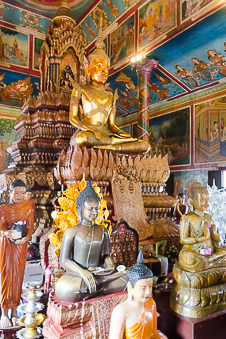
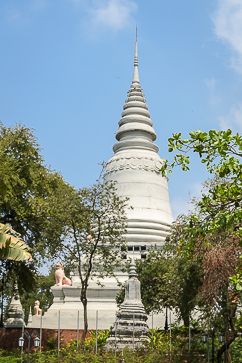
Wat Phnom: Cambodian legend tells the story of Yea Penh (Lady Penh) who, in 1372, fished a Koki tree out of the river and found four Buddha statues inside. Taking this as a sign, she built an artificial hill and placed a temple on top to house these divine relics. The surrounding area took on the name of this place, Phnom Penh, or Penh's Hill.
The two main structures now sitting atop the hill are the Main Prayer Hall, constructed in 1926, and the stupa containing the remains of King Ponhea Yat (1405-1467), who was responsible for relocating the capital of the Khmer Kingdom from Angkor to Phnom Penh.
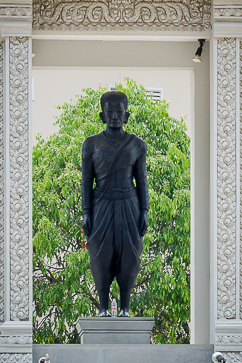
Yea Penh Statue: We had planned to next walk to the location of Peep's lunch meeting with her boss, but just before entering Wat Phnom she received a phone call informing her the location had changed. Rather than trying to find the new place on our own, we agreed to have them pick us up at Wat Phnom. A shaded park with benches surrounds the hill, so Peep sat and reviewed some documents while I took a few minutes to cross the street and get a daylight view of Yea Penh Statue.
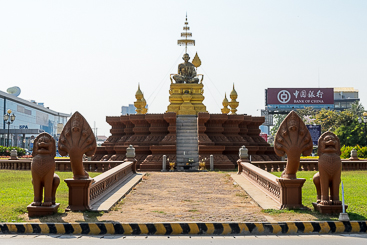
Statue of Samdech Songreach Choun Nat: After lunch at a Mexican restaurant, we were taken to Peep's boss's office, where the two of them sat down to continue discussing business. After refilling my water bottle, I headed out on foot to see more of the city. I eventually came upon the Statue of Samdech Songreach Choun Nat, onetime Chief of Cambodian monks and credited with preserving and promoting Cambodian culture in the twentieth century, including significant contributions to the Khmer language dictionary. I continued walking around a short time before making my way back to the hotel to await Peep.
Evening: Peep arrived several hours later and had a few moments of rest before getting ready for dinner out with her boss and several other coworkers. We were again picked-up and taken this time to a very good Italian restaurant. After dinner, Peep's boss sent us home in his car while he walked back to his condo, which was just around the corner from our dining place.